
My latest piece at PaganSquare, talking about discovering the divine spirits in local folklore.
Genii Loci: Communal Spirits of Place – PaganSquare – PaganSquare – Join the conversation!.

My latest piece at PaganSquare, talking about discovering the divine spirits in local folklore.
Genii Loci: Communal Spirits of Place – PaganSquare – PaganSquare – Join the conversation!.
I’m excited to announce that you can now find me blogging over at PaganSquare in my new blog Do ut Des.
Introduction to Do ut Des – PaganSquare – PaganSquare – Join the conversation!.
 Historically the month of February for a Roman had an overarching theme of purification and setting things right with the Lares (our Ancestors and Heroes) and the Manes (our Dead)1. Interestingly, this habit of feeding the Dead did not stop with Roman Polytheists at the time, but it was also a custom of early Christians. This custom has continued to be carried out into modern times, and we see its Christian heir in the varying traditions held in All Saints’ and All Souls Day. In fact, some scholars point to All Saints’ and All Souls’ Day being a modern survival of February’s Parentalia.
The Parentalia was a 9-day festival that was mainly celebrated in private, attending to your family’s unique Lares and Manes. It begins on the 13th of February. In my home, we also spend the 9-days of Parentalia sacrificing to the Lares and Manes with offerings of flowers, wine, salt, corn2, and cake. I’ve written more about how my family observes Parentalia, and Helio at Golden Trail also offers how he is observing Parentalia this year.
It’s the final day of Parentalia that I wanted to talk about, though. It was important enough to the Romans that it had its own name: The Feralia.
The Feralia was a public sacrifice for the Manes held at midnight on February 21st, the final day of the Parentalia. We have no surviving description of what the public rites entail, though if we take Ovid’s account in his poem, Fasti, it likely had magical undertones that one did not find in many Roman festivals. Ovid also speaks of the Dead being appeased by offerings of floral wreaths, a little grain, a little salt, bread soaked in wine, and violets, though other offerings are permitted. These were to be taken to the family’s tombs outside of the city, and they picnicked with their Dead.
Ovid tells the tale of a year when the Romans were so busy with fighting war that they neglected the Feralia. The Manes raised from their tombs and took to the street. They angrily howled and roamed until the living paid tribute.
I am still trying to build meaningful traditions for my family within regionally-sound cultus, and Feralia is one of the festivals that I find overlaps in other times of the year within my extended family’s traditions. When I think of Feralia, though, my mind keeps coming back to Ovid’s story of the roaming, forgotten Dead.
While I will privately honor my own Manes with a modest sacrifice of black beans, cracked corn, wine, and flowers, my mind continues to move back to a way to honor the Unclaimed Dead and those who have never been found. In November, I read an article from the L.A. Times about the large number of Unclaimed Dead that exist, and months later it still haunts me. I realized upon reading it that if in a large city like LA an average of 6 people a day go unclaimed, this means nationally the numbers of those unclaimed are likely huge. Or at least large enough that it would hurt my heart to try to calculate. Babies. People who were homeless. People whose relatives were unable to afford getting the bodies brought home. People who have no family.
As a Roman Revivalist, I seek to adapt historical Roman Polytheism to my modern life, which means that I am comfortable moving away from Reconstructionism when it is needed or simply the Gods wish it. In the case of the Feralia, I have taken the line from Ovid’s Fasti, as translated by Betty Nogle, which states, “They called this day Feralia because they do what’s fair.”
In other words, they brought what was due to the Manes, the Dead.
One of the things that drew me to Roman Polytheism so many years ago was the concept of public virtues as laid out by Nova Roma. These are virtues are those of a healthy, whole society. One of these virtues is Pietas, piety or dutifulness, which Rome claimed was their reason for success. When I speak of piety, I do not just speak of what we owe the Gods in a natural contract between humans and Powers. I speak of respect of our duty to our fellow humans, our communities and society at large.
In the United States especially we have turned away from this virtue on the very basic level of societal contract when we allow our fellow humans to starve and freeze to death on the streets. We shame those who find themselves in need of public assistance, ignoring that one of the icons of our country, the Statue of Liberty, the personification of what we believe to be an inalienable right, has a poem by Emma Lazarus that many of us can quote the end of:
Not like the brazen giant of Greek fame,
With conquering limbs astride from land to land;
Here at our sea-washed, sunset gates shall stand
A mighty woman with a torch, whose flame
Is the imprisoned lightning, and her name
Mother of Exiles. From her beacon-hand
Glows world-wide welcome; her mild eyes command
The air-bridged harbor that twin cities frame.
“Keep, ancient lands, your storied pomp!” cries she
With silent lips. “Give me your tired, your poor,
Your huddled masses yearning to breathe free,
The wretched refuse of your teeming shore.
Send these, the homeless, tempest-tossed to me,
I lift my lamp beside the golden door!”
To me being a citizen of the United States means that every other person living in my country is, in a way, extended family. We are part of the same tribe, so to speak. When people are unable to provide for themselves, it is our duty to care for them, because we reasonably have enough as a collective body that no person should go without the basic needs of the living. We forget this. We attempt to quantify and qualify who deserves more or less based on their ability or circumstances in life. When we do this, we fall victim to hubris and the feeling that we are somehow superior to those of our extended, civil family in every way, shape, and form. We ignore that we are connected.
And if we are all connected, if we are all in this together, then it is the duty of those who believe in the Ancestors and Dead to care for them as well. The nameless, faceless Dead, forgotten and ignored by our society at large, are our family. They’re our brothers, sisters, and everything in between. Some of them we have failed while they were living. Some of them came into this world and out again in the blink of an eye. Some simply were not able to make their journey home to their final resting place.
But they shouldn’t be forgotten.
We Pagans and Polytheists have a chance to set these moments right. Those who believe that we still have a relationship with the Dead are able to reach out to them and let them know that They are not forgotten. That we honor Them. That we give Them what They are due as members of our extended family and tribe.
I invite you to observe the Feralia in honor of those Unclaimed Dead on February 22nd. As a larger community, let’s take a moment out of our year to give to those who may be lost and wandering still. When the sun goes down, let’s all take a moment to step outside and leave modest offerings to those so many forget. If you are able, consider joining me during the 9 days of Parentalia in performing an Ancestor Elevation for the Unclaimed Dead, along with your own personal Ancestors. For those unfamiliar with the ritual, Galina Krasskova has written a beautiful ritual that could easily be adapted to the purpose or done as is.
Even if on this day you’re only able to offer a moment of thought or prayer, please do so. Let us not turn our head away from the Dead, lest the Dead take to the streets demanding Their due.
Let us do what is right.
Georg Wissowa’s classifications of indigenous and foreign cults gives the best illustration of the obsessive search for the “true” religion of the Romans, of the illusory project of studying their religion in the purest state possible. Now like any culture or language, a religion is never and never can be pure, uncontaminated. It is always the result of mixture, even at the earliest stages we are able to identify. So the sorting out of Roman and non-Roman elements, or for later periods a concept like syncretism as opposed to a “pure” religion, are nonsense.
Graeco Ritu: A Typically Roman Way of Honoring the Gods, John Scheid, Harvard Studies in Classical Philology. Vol 97, Greek in Rome: Influence, Integration, Resistance (1995), pp. 15-31
I have about a billion emails I am trying to get responded to. My head has been off in, well… The Norse Nine Worlds, actually. Not just in the clouds. Those waiting for me will be getting responses by tomorrow afternoon.
Because it matters. A lot. I don’t have the energy to rant, because I threw my shoulder out. But seriously, it matters.
Oracle for February is shut down and to resume in March. February is for purification in my tradition, and all other spiritual services are halted until the turn of the New Year in my religious calender.
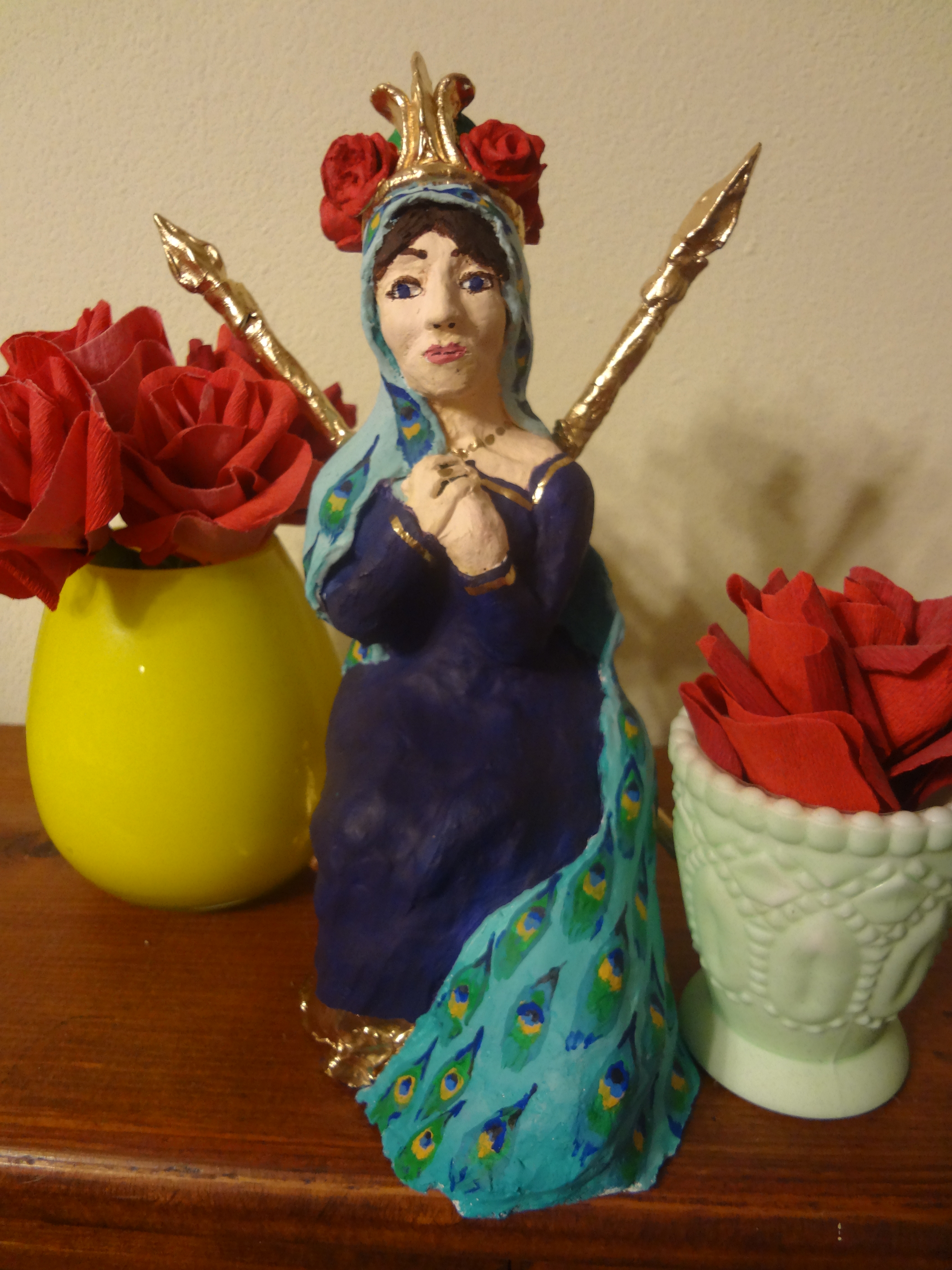
Galina Krasskova is running an agon for Juno until February 14th, and I would encourage everyone to send a prayer or piece of art in Juno’s honor for this. This is my entry. I’d been waiting for the statue’s clay to dry, and Galina’s announcement gave me the last little kick I needed to motivate me in completing this. For that I’m very thankful.
This statue is going to be placed for the first time on my shrine tomorrow for the Kalends of February, which happens to be Juno’s die natalis, or birthday, as well. Both Juno and Janus recieve cultus in my home on the Kalends of the month, and She has a special place here, having been openly prayed to at my wedding to my mortal husband. I will have to remove the on a sunny day to put a protective coat over the paint, but I’m very pleased with how She turned out.
It seemed natural to sculpt Her first.
Lately I’ve been thinking about my return to art after so many years of walking away from art school. We were recently looking through my portfolio of work from my high school years, and most of the drawings and paintings were related to mythology. I’d always considered myself a figurative artist, but looking over it recently I realized that my focus had always fallen back to Deities and Spirits.
I look back at my critiques in Chicago, and I think beyond my depression and pain I felt from my work being torn apart, I was told regularly my art fell in the genre of fantasy. I had (and still have) quite a bit of technical skill to master, and I was never unaware of that. However, I have always felt a sense of sacredness to the work I do in the realm of art. Meditating upon it now, I feel a deep awareness that I didn’t take those critiques as simply a technical critique… Those pieces of art were my statement of my belief in the Gods, and even as a teenager that was a very serious thing to me. My art has never been fantasy any more than a Christian would call a painting of Jesus a piece of fantasy.
It’s taken me years to get to a place where I feel comfortable making art again, and it’s only with that comfort that I’m realizing that I didn’t just feel attacked on my talent and skill but my very beliefs.
This ramble is basically just a note of thanks to those reading my blog and encouraging me to continue creating. I’m so happy to have found others who believe in the Gods as I do, or close enough that we can consider each other co-religionists.
Thank you.
Also, be looking out for an exciting announcement coming from me! (Not the opening of my art store either!)


A most excellent article by TP Ward on a way to approach treatment of depression in our communities. I’m excited to see this conversation happening more and more!
All messages should be sent out now, and all clarifications as well. Next month I will be taking off for yearly purification, but expect to see a March call put out.
Thank you to everyone who offers me the opportunity to help them.
This is really a fantastic idea!
 Foxglove & Firmitas